Early in my career I was sat in front of Search Console, looking at the inbound links to the website of the company I worked for, and I asked my manager what I thought was a reasonable question.
Who are these people? Why are they linking to us?
He didn’t look up. “Don’t ask, don’t tell. And for the love of god don’t click onto any of those sites, you’ll break the company computer.”
For a good chunk of my career, a legitimate line on a marketing budget was buying votes.
Nobody called it that.
It was “outreach”. A spreadsheet of two hundred domains that sounded like a shaken dictionary, nine hundred words nobody would read, on a site nobody had visited, wrapped around one link back to your client.
And it worked. Annoyingly.
An industry of clever people, agreeing not to say out loud what we were doing. And pretending it wasn’t spam.
Then it got harder, on purpose
What I didn’t realise at the time was that I’d joined the industry during the wild west. The rest of my career was Google playing whack-a-mole against an ever-growing litany of loopholes and clever hacks.
Backlinks had become a signal-to-noise problem, and they took some big swings at cleaning it up.
- Nofollow killed comment spam.
- Penguin killed the link farms.
- Disavow was the amnesty desk.
- 2014 gutted guest blogging.
And from the very beginning, not all backlinks were born equal, and the gap kept widening. The good ones got better. The cheap ones went from worthless to toxic.
So the job drifted into PR, complaining all the way. Real stories pitched to real publications. Partners linking to each other because they actually worked together and wanted people to know.
Then in 2019 Google asked the entire web to annotate its relationships: sponsored, user-generated, or a genuine editorial endorsement. A request that was broadly ignored.
Links had stopped being just votes and started being declarations. For anyone who could be bothered to declare.
What it had been asking for all along
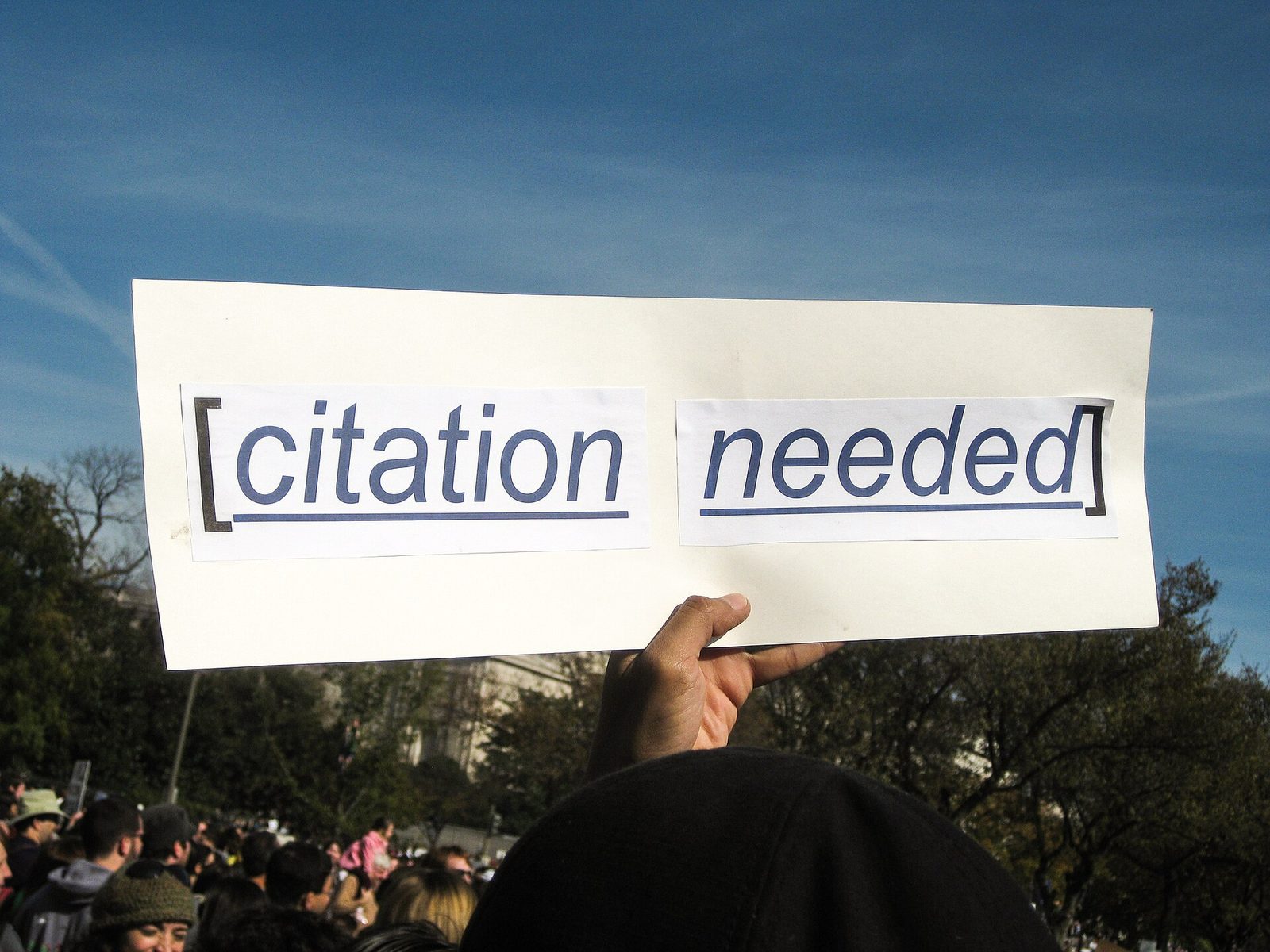
Google’s original name was BackRub, because what it did was analyse back links. It’s a good bit of trivia down the pub, but it’s far from trivial.
PageRank is citation analysis with the serial numbers filed off, lifted from bibliometrics and from Eugene Garfield’s insight in the fifties that counting citations tells you what mattered. People have since traced the line from Garfield straight to Google, if you want the academic version.
Here’s the mechanic.
You want to understand psychology.
You’ve been handed a library of four million papers and you cannot read them.
But you notice that thousands of authors, independently, keep pointing back at Freud.
You’ve read none of it. You now know exactly where to start.
That’s Google. A digital librarian taking a shortcut past everything published, straight to whatever everything else refers back to. It assessed nothing itself. It followed the people who had.
A link is a citation. A citation is a vote. Enough votes from people who get cited themselves is authority.
Twenty-seven years old, still the whole philosophy.
The loophole was never the rule. It was the proxy.
Google couldn’t read everybody’s page and judge whether it deserved pointing at. Not at that scale, not in 1998, and not for another twenty-five years. So it counted who else had pointed, and inferred the rest.
The score was a proxy. Proxies can be forged. My early career was the forgery, and Google, of all things, spent the following decade straightening me out.
Every update since has been Google closing the gap between the proxy and the point.
Which reframes the current moment entirely. A machine that reads your work and judges it directly isn’t a break in that trajectory. It’s the finish line.
Nobody moved the goalposts. Somebody turned the lights on.
They even announced it. In 2022 they added an E for Experience: first-hand, were-you-in-the-room. The industry read it and bought more links.
That was roughly when I started asking the obvious question. Why keep fighting the system when you could go with its intended flow? The industry broadly disagreed, because it is much easier to sell two hundred domains than “your managing director needs an opinion, with their name on it”.
Why the traffic stops
Sixty-eight percent of US searches now end without a click. Everyone’s asking why Google would send traffic to a page when Gemini can answer the question itself.
Wrong question. It assumes traffic was ever the deal.
Google was never in the business of sending you visitors. It was in the business of answering the query, and it pointed at the librarian’s shelf because it couldn’t read the book aloud.
Traffic was never the promise. It was the limitation. The limitation has been lifted. Bad news for you if that was your number one pet metric.
Not that I’m above wanting the visit. I want people on my site getting the full brand experience, which is precisely why I spent a couple of years building a tool to hold back the AI tide as it came in. I was right about the stakes and wrong about the defence. The job was never sessions. It was always the proliferation of the information.
If you’re reading this you’re probably thinking, assuming you haven’t had a full-scale AI-induced cognitive surrender, that Google still needs the open web or there’s nothing to synthesise.
True. But that dependency is aggregate. It needs the corpus. It doesn’t need your click. Which is exactly why Cloudflare is now pricing crawls.
SEO and GEO, said properly
SEO is the prominence of your information over everyone else’s, in a ranked order.
GEO is the prominence of your information over everyone else’s where there is no order.
It’s all or nothing. A zero-sum game.
Ranking was graduated. Position seven still got a trickle: a bad month rather than no month. There is no position seven inside a generated answer. You’re in the synthesis or you don’t exist.
And search used to fuse three things that generation has pulled apart. You ranked, they clicked, your name was on the page. One event. Now your thinking can shape an answer while your name appears nowhere in it.
So there are two prizes.
Attribution is a flow. You’re re-selected from scratch every query, and yesterday’s citation buys you nothing.
Influence is a stock. Publish first-hand material often enough and you stop being retrieved and start being known.
Most people selling GEO are optimising the flow and quoting the stock. Worth asking anyone who pitches you which of the two they’re building, and how they intend to show you.
What follows
The average link loses value. The high-authority backlink keeps it. And the unlinked mention gains. A named appearance in a trusted title is a training deposit and a retrieval candidate, href or not.
So digital PR doesn’t die. It finishes the journey it started in 2012.
And the test gets embarrassingly simple. Could your nearest competitor have published this? Or worse, could the machine have written it without you?
If yes, bin it. Nothing summarising your category has any reason to point at you rather than at your competitor, or simply at itself.
If no, because it came out of one specific person’s head and their actual experience, you’ve got something. It might not rank, but that was never the job.
The job is to control what the customer gets told. About your category, about your product, about you.
So what actually counts as quality?
The word has been so thoroughly abused by content marketers that it means nothing. Here is what I think it means now, and every one of these is a thing a machine cannot generate from what it already holds.
- Original data. First-hand, or synthesised from existing sources into something genuinely new. A survey you ran. A pattern across a dataset only you have looked at properly.
- Lived experience. The thing you actually did, not the thing you read about someone doing.
- Privileged access. A room, a client list, a decade in an unglamorous niche. Something a stranger cannot simply look up.
- A named idea. Give a pattern a name and you hand people a handle to grab it by. Named things travel, and travelling things get cited.
- Conviction. Machines are exceptional at balance and hopeless at nerve. A position somebody could disagree with is a position worth quoting.
- Repeatability. Not virality. The much quieter quality of being easy for one person to relay accurately to another. You could call it “dark social” if you want to be all 2020s about it.
Try this before you commission anything. Ask the machine the question your best customer would ask, and see who gets named. Then look at what the named ones have in common. In my experience it isn’t budget and it isn’t publishing volume. It’s a person, attached to a claim, who can be looked up.
Which is the argument arriving from the other direction. Your firm already holds the expertise. The only live question is whether it’s visible enough to be cited.
Getting it out of your people reliably, rather than heroically, is a separate problem, and I’ve written about that one too.
Freud didn’t get cited for publishing four times a week.
One correction, while I’m here
“If you’re not the citation, you’re the training data.” That’s how I put it when I switched Content Shield off, and I now think it’s only half right.
You want to be the training data. That’s the stock. That is how you become the thing the machine simply knows about your category, without having to be retrieved and re-argued every single time.
You just don’t want to be only that.
You’re going into the corpus either way. The only question is whether your name goes in with you.