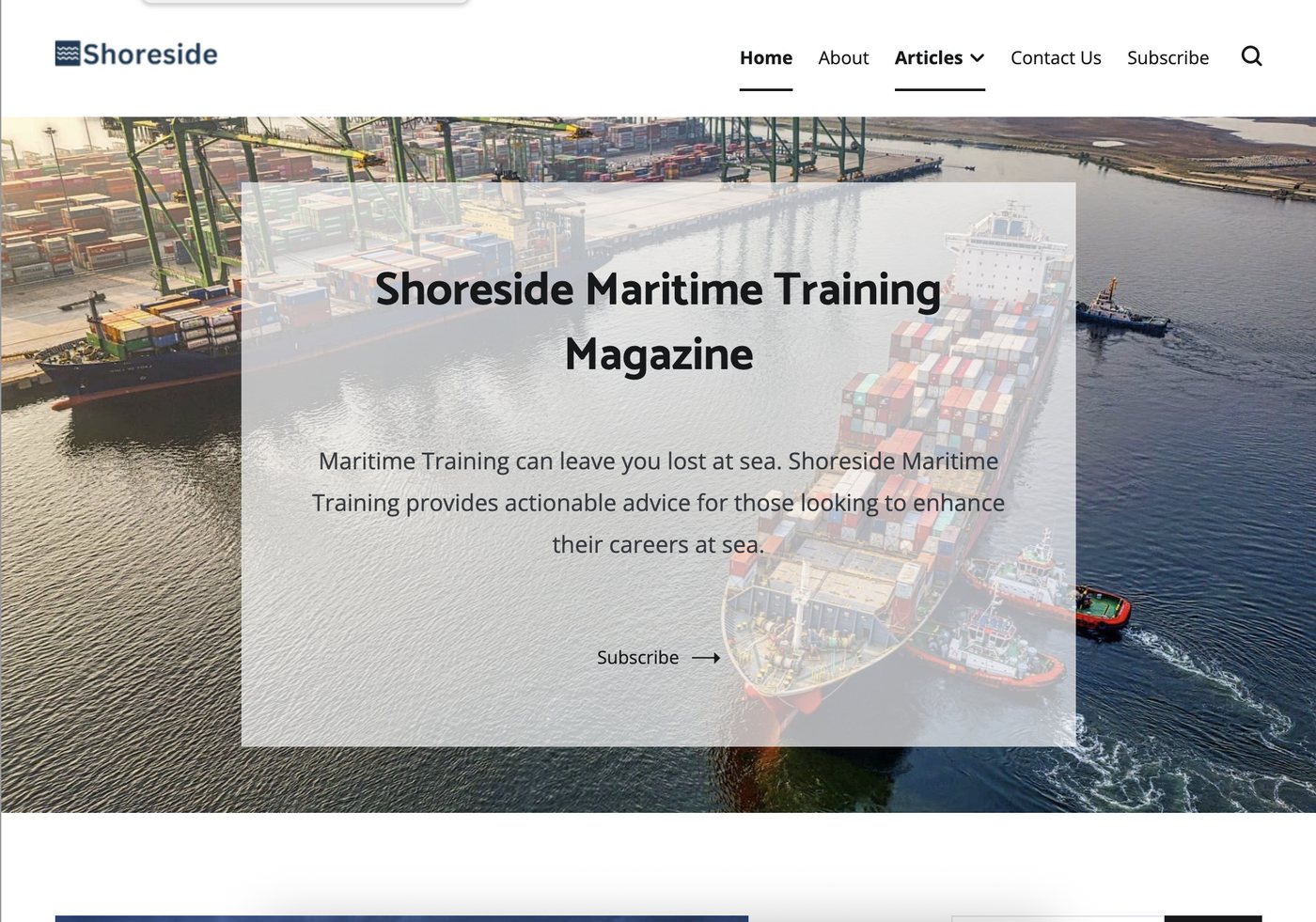
This month I’m closing Shoreside Maritime Training, six years and around ninety articles after I built it to help people find their way into the Merchant Navy. Before the how and why, it’s worth explaining why I was ever the right person to create a website providing career advice to people wanting to join the Merchant Navy.
I was in the Merchant Navy myself, weeks on, weeks off, living aboard, fresh out of school. My father was a Merchant Navy officer. So was his father. I grew up in Thanet, where you’re never far from the shoreline or the industry that runs off it. I spent Christmas aboard industrial ships as a child. This world was mine long before I ever wrote a word about it, three generations before, in fact.
Years later, in marketing, I worked with the Viking Group, alongside other clients and industries, Viking Crew, Maritime Skills Academy, and Chiltern Maritime among them, running SEO and content for their cadetship work. I left that agency, plenty of time passed, and I hasten to add any reasonable non-compete either I or the agency had was long since spent by the time any of this happened. Chiltern’s own content started thinning out on the web not long after, and the company itself eventually went into voluntary liquidation.
Watching genuinely useful information for young people deciding whether to go to sea just disappear felt like a waste. So in 2020 I rebuilt the resources, in my own words, from what I already knew, not from anything I’d written for a client. Guides to actually getting into the Merchant Navy: deck officer, marine engineering, apprenticeship versus cadetship, department by department.
Monetising Written Content & Feeling the Love
Shoreside Maritime Training ran on Google AdSense and nothing else, one of a few side projects I’ve run over the years to prove I’d actually pay for the service I sell, alongside UrbanFox Club. It worked. It made real money off nothing but knowledge, written down and presented back to the market properly.
I wrote it under a pen name, Peter Roberts, a nod to the Dread Pirate Roberts, mostly because it was fun. What mattered more was what it did for the site: Google trusted “him” the way it trusts an author with a track record, and that trust compounds. Convenient, for someone who doesn’t exist.
People emailed to say the guides had actually helped them get in. Others emailed with grievances about specific training providers, wanting me to go after them. I knew exactly what kind of publication I was running, and it certainly wasn’t the start of a burgeoning career in investigative journalism, so respectfully, I chose not to go there. But the fact people thought the site carried enough authority to bring their grievances to it in the first place says something about the quality of what we’d built.
The site picked up backlinks from forums and social media users without me chasing any of it, and an infographic I’d made explaining the structure of the Merchant Navy started turning up in training material used by maritime colleges. Nobody asked permission. The information was just doing its job.
Building a Tech Stack
Alongside designing and developing the website itself, and learning more about development than I ever really needed to in agency work, I also started developing proprietary technology to monitor the release of press releases and legislation changes across the industry, because RSS had stopped being reliable and I couldn’t afford the time to check by hand. For a while, it let me publish faster than almost anyone else in the space.
The AI-pocalypse
My content had become so useful it ranked well with Google, and imitation being the highest form of flattery, competitors would regularly lift and shift my articles, publishing an equivalent version on a cycle of about one to two weeks after mine went live.
Then AI LLMs entered the market, and that behaviour changed almost overnight: the turnaround window collapsed from a fortnight down to under half an hour. That was the observation that led directly to Content Shield. The AI had effectively eaten my lunch, taking away the Google AdSense monetisation by reducing sessions on the site and handing the crumbs of the traffic to my competitors. It stopped being a good ROI on my time, and that’s the real reason Shoreside went quiet, not any loss of interest in the subject. Just boring economics.
It’s been mostly dormant for three years. Rather than let it rot quietly or hand it to someone else, I’m closing it properly.
The Final Win
Content Shield wasn’t the only phoenix to rise from these ashes. The monitoring system survived too. It’s the direct ancestor of what I’m building now: letting experts respond to their own industry’s news properly, instead of finding out three weeks late.
You can build real authority from nothing but what you know, written well and put in the right place.
The point of all this was never really the Merchant Navy, useful as that guidance was. It proved I could do it: build real authority and get discovered for what I actually knew, starting from nothing. That’s exactly what I now help other people do. And if I’m going to take client money to build them that kind of authority, I’d better be able to say I’ve built it myself, and paid for the privilege of learning how.