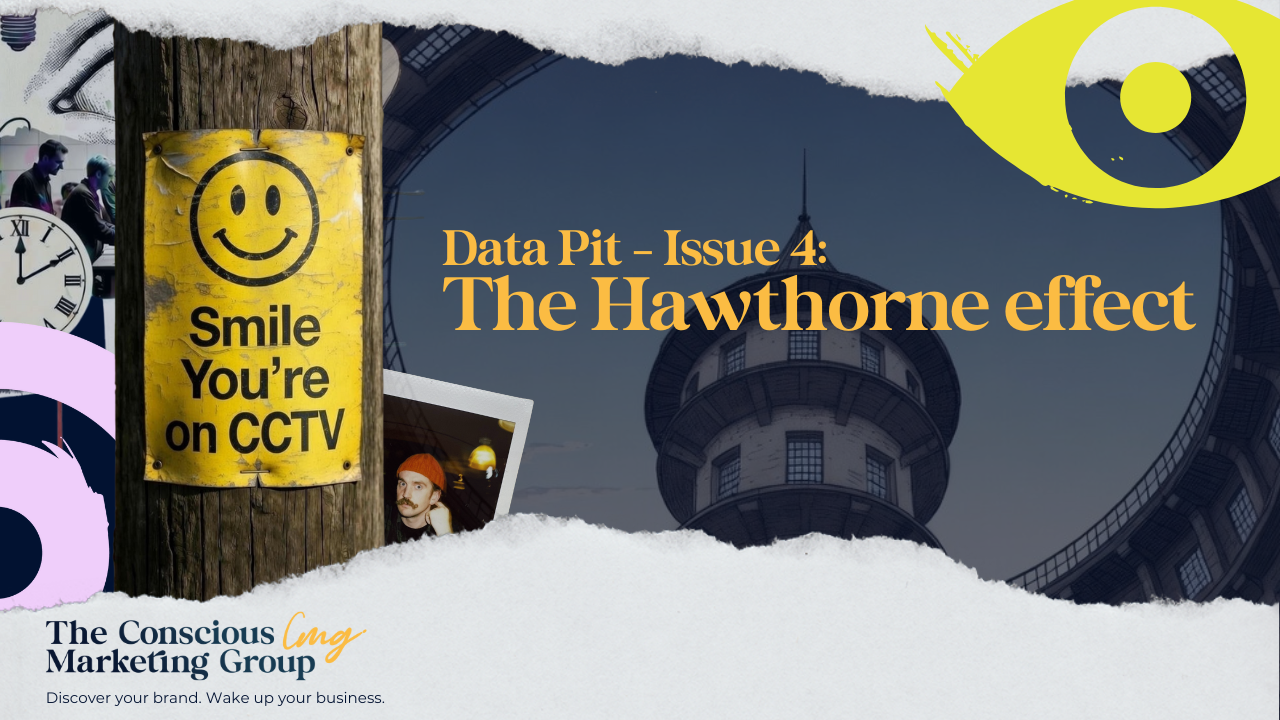
I could start this by talking about quantum superposition. About how particles behave differently when observed. About measurement collapsing the waveform. About how a split test is basically Schrödinger’s landing page.
But let’s be honest. None of us are subatomic. And the best modern example of the Hawthorne Effect isn’t found in a lab. It’s found in the Big Brother house... or I guess Love Island if you’re slightly younger than me.
Lock a group of people in a house, surround them with cameras, and reality collapses into performance. Every conversation, every confession, every breakfast argument becomes theatre. The channels called it reality television. Psychologists call it the Hawthorne Effect. Because observation changes behaviour. Always has.
You can see it everywhere in the marketing profession:
- when office productivity spikes the week a new time-tracker launches.
- when creatives tidy their ideas the moment a client joins the call.
- when focus group participants become moral perfectionists under a one-way mirror.
- and when brands learn to write posts for algorithms instead of audiences.
Every layer of marketing has its own camera. Perhaps a more relatable experience for anyone who attended school in the UK would be Ofsted inspections, where Miss Trunchbull becomes Miss Honey for one day of the year.
What it actually is
The term comes from a set of experiments in the 1920s at the Hawthorne Works factory outside Chicago. Researchers wanted to test how lighting affected productivity.
They turned the lights up. Output improved. They turned the lights down. Output improved again. Eventually they realised the lights were irrelevant. Productivity rose simply because the workers knew they were being watched.
Attention itself had become the incentive.
Inside marketing
1. Internal productivity
New dashboards, time trackers, and workflow tools promise efficiency but mostly measure presence. For a week, inboxes move faster, Slack lights burn later, and everyone looks busier. Then it fades. The tool didn’t increase productivity. It increased performance anxiety.
2. Creative distortion
Creatives behave differently under observation. Record a brainstorm and you get structure, not surprise. Invite the client and you get polish, not play. Observation kills risk and rewards coherence. Big ideas shrink to fit the room.
3. Consumer research
The Hawthorne Effect is everywhere in market research. Ask people what they will do and they tell you who they wish to be. Watch them, and they act that part for as long as they know they are being observed.
You see the same thing in the American TV show What Would You Do? Hidden cameras capture everyday dilemmas, and strangers intervene only once they realise the cameras are there. It’s not dishonesty, it’s choreography. Consumers in labs are no different. They recycle more, pay more, care more, until the clipboard leaves the room.
4. The algorithmic observer
Today, the watcher isn’t human. It’s the feed. Once the algorithm begins ranking our output, we start performing for it. Writers shape headlines for click models. Designers tweak colour for dwell time. Brands chase whatever metric sits closest to the “boost” button. It’s the Hawthorne Effect at industrial scale: visibility loops disguised as insight.
How to catch yourself
Before you celebrate a spike, ask:
- Did behaviour actually change, or did visibility improve?
- Would these results hold if no one was watching?
- Are we optimising for performance, or for the performance of performance?
- Do we still act the same when the cameras go off?
If the answer is no, the Hawthorne Effect is already at work.
Guardrails
- Normalise observation. The less novelty in being watched, the less behaviour distorts.
- Measure lagging, not live. Immediate feedback changes behaviour. Delayed feedback shows truth.
- Rotate what you track. If people know what metric matters, they’ll perform to it.
- Reward consistency, not spikes. If progress fades when the spotlight moves, it wasn’t progress.
- Check the afterglow. Wait a week. See what remains once the cameras cool.
The napkin test
If your data holds steady when no one knows they are being measured, you are seeing real progress. If it collapses when attention moves elsewhere, you’ve built theatre, not truth.
Close but not quite
- McNamara Fallacy: counting what is easy instead of what matters.
- Simpson’s Paradox: adding data that reverses the result.
- Hawthorne Effect: changing behaviour because you know someone is counting.
When Big Brother first aired, the producers thought they were building a social experiment. What they actually built was a mirror. The moment the cameras switched on, people changed. The moment they switched off, they changed back. It led to consistent diary room entries about who is being “authentic”. The answer being none of them.
Marketing does the same thing every day. The only question is whether the work is real when the observation ends. If a tree falls in the woods…
At Conscious Marketing Group, we uncover the messy truths behind data and turn them into creative momentum. We make brands relevant, interesting, and easy to choose.
The first step is an outside sense-check of your data practices, before the spotlight starts writing the story.
 Subscribe on LinkedIn