I spent the last five years optimising for the wrong metric.
My goal, when I started learning Dutch, was to make my girlfriend laugh by making a joke in Dutch that was actually good and ‘off-the-cuff’.
My phone buzzes every morning at 08:02. Duo the owl stares up at me, wide-eyed and unblinking, promising fluency in exchange for a few more XP. I oblige. I have done it for 1,901 consecutive days. The number is satisfying. It feels like progress.
But have I become fluent enough to make a good joke in Dutch to my girlfriend? Nee. Nauwelijks. I am exactly where I was three years ago. Only now with friendlier notifications.
What this has to do with Robert McNamara
Robert McNamara, U.S. Secretary of Defense during the Vietnam War (stick with me here), made the same mistake, just on a much larger scale. He measured progress by counting enemy body counts, sorties flown and bomb tonnage dropped.
Obviously a terrible way to measure a war. The numbers looked “great”. The dashboards of the day, piles of punched cards and mainframes, all said the same thing: winning.
But while the data said progress, the war said otherwise. The things that mattered, morale, support and stability, were never measured because they were messy, subjective, human. And when the meaning disappeared, only the metrics remained.
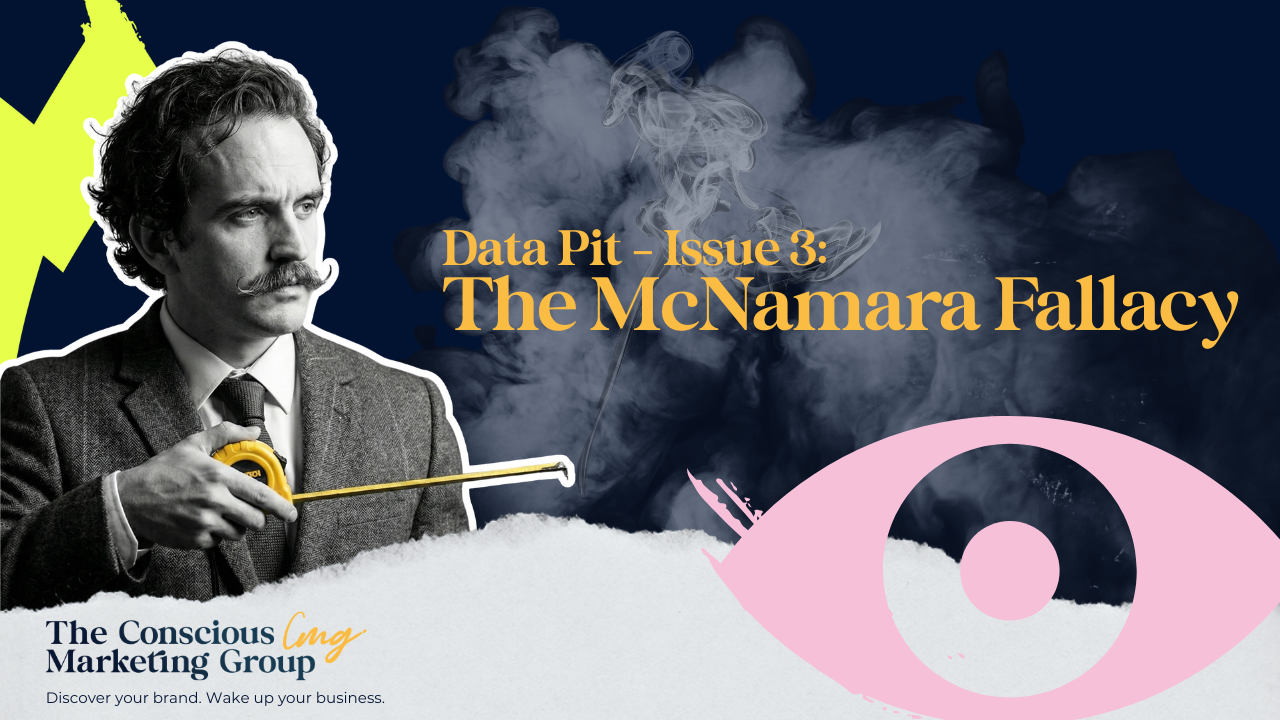
That pattern has a name: the McNamara Fallacy, when what is easiest to measure replaces what is actually important.
The marketing version
We do this all the time. We measure what is available, not what is valuable. Clicks. Impressions. Reach. Followers. Nice, countable, export-to-CSV numbers that reassure us we are in control.
But unless those metrics connect to something tangible, like revenue, recall, reputation or retention, we are just perfecting the wrong thing.
You can optimise yourself into irrelevance. You can get fitter at counting reps without ever getting stronger.
Where you will see it
- Campaigns that celebrate impressions while conversions flatline.
- Brands chasing engagement spikes instead of loyalty.
- Teams reporting on the number of posts as proof of brand awareness.
- Dashboards that measure efficiency but never effectiveness.
Each looks like progress until you ask, “Progress toward what?”
The next measurement crisis
I keep thinking about what happens when search itself stops being a list of links and becomes a single answer.
Right now, we already struggle with measurement. We try to attribute everything perfectly, to trace every click back to its origin story. It is a comforting illusion of control.
But with AI search and LLMs, even the shaky proxies we rely on, like Search Console impressions, click-through rates and query data, start to disappear. For smaller brands, those were the last visible breadcrumbs between marketing effort and real-world behaviour.
If they vanish, we are left with a choice. Either we realign around purpose, focusing on the outcomes that actually matter, trust, recall, usefulness. Or we spiral into a new crisis of justification, inventing ever-flimsier numbers to explain why we did what we did.
It could be a renaissance for meaning. Or another golden age for dashboards that measure nothing.
How to catch yourself
Before you open another analytics tab, ask:
- Is this metric a proxy, or a purpose?
- Would this still matter if the client or CFO did not see it?
- Does it tell me what is happening, or just that something happened?
- If the dashboard vanished tomorrow, how would I know we were succeeding?
If you cannot answer that last one, the number owns you.
Guardrails
- Measure the mission, not the motion. A metric that moves is not automatically progress. Ask what it is moving toward.
- Pair every quantitative metric with a qualitative one. Numbers tell you how much. People tell you why.
- Keep a KPI kill list. Once a metric stops serving a decision, retire it. Vanity numbers spread faster than truth.
- Ask the “so what?” question at every review. If the team cannot answer in one sentence, you are optimising for optics.
- Balance the invisible. Trust, brand sentiment, creative quality. The things that do not fit neatly into a spreadsheet are often the ones holding the rest together.
The napkin test
If your metric can rise while the outcome gets worse, you are measuring the wrong thing.
Tactful pushbacks
Slack or email: “Before we optimise for reach, can we confirm reach still correlates with revenue? Otherwise, we might just be measuring volume.”
Stakeholder-friendly: “What we measure is what we make more of. Let us make sure we are counting the right things.”
Close but not quite
- Cobra Effect: when an incentive backfires and creates the opposite behaviour.
- Simpson’s Paradox: when segmented truths flip at the aggregate.
I still open Duolingo every morning. The streak ticks on. Duo still cheers. But now, when the app congratulates me for learning “vliegtuig” for the tenth time, I close it and try something radical.
I make a joke. In Dutch. It Netherlands. But at least I am measuring the right thing.
At Conscious Marketing Group, we uncover the messy truths behind data and turn them into creative momentum. We make brands relevant, interesting, and easy to choose.
The first step is an outside sense-check of your data practices, before the metrics start running the mission.
 Subscribe on LinkedIn